WIP Value Summary
Description:
Report to get the WIP and Material accounting distributions, by WIP job,period, Org . It displays detailed information from both sources WIP and Material Transactions Parameters: =========== Period: To pull the transactions based on specific inventory period ( transaction_date).(mandatory) Source: enter the source “WIP”,”Material” or “Both” you wish to report (mandatory). Category Set 1: any item category you wish, typically the Cost or Product Line category set (optional). Category Set 2: any item category you wish, typically the Inventory category set (optional). Category Set 3: any item category you wish, typically the Inventory category set (optional). Replace Colon with Dot: This is to give flexibility to replace concatenated segments ‘-‘ with ‘.’ . If Yes, it wil always replace (optional). WIP Job or Flow Schedule: enter the WIP Job or the Flow Schedule to report (optional). Organization Code: enter the inventory organization(s) you wish to report (mandatory). Operating Unit: enter the operating unit(s) you wish to report (optional). Ledger: enter the ledger(s) you wish to report (optional).
Parameters
Period Name, Organization Code, Source, Category Set 1, Category Set 2, Category Set 3, WIP Job, Operating Unit, Ledger, Replace Colon with Dot
Used tables
gl_ledgers, org_organization_definitions, wip_transaction_accounts, wip_transactions, wip_entities, wip_discrete_jobs, gl_code_combinations_kfv, xla_transaction_entities_upg, org_acct_periods, xla_events, xla_ae_headers, xla_ae_lines, xla_distribution_links, hr_operating_units, mtl_system_items_vl, wip_repetitive_items, bom_departments, bom_resources, mtl_material_transactions, mtl_transaction_accounts, mtl_item_locations_kfv, mtl_transaction_types, cst_cost_elements
Categories
Related reports
CAC Receiving Activity Summary
Dependencies
If you would like to try one of these Oracle EBS SQLs without having Blitz Report installed, note that some of the reports require functions from utility package xxen_util.
Example Report
Report SQL
www.enginatics.com/reports/wip-value-summary/
Blitz Report™ import options
Case Study & Technical Analysis: WIP Value Summary Report
Executive Summary
The WIP Value Summary report is a crucial cost accounting and financial reconciliation tool for Oracle Manufacturing, providing a detailed breakdown of both Work in Process (WIP) and Material accounting distributions. It offers a consolidated view of costs by WIP job, period, and organization, drawing information from both WIP and Material Transactions. This report is indispensable for cost accountants, production managers, and financial analysts to understand the detailed flow of manufacturing costs, reconcile subledger data to the General Ledger, analyze variances, and ensure accurate financial reporting across different stages of the production cycle.
Business Challenge
Accurately tracking and reconciling manufacturing costs involves complex data from both Work in Process and Inventory modules. Organizations often face significant challenges in gaining a unified and detailed view of these cost flows:
- Fragmented Cost Data: Information about costs incurred in WIP (labor, overhead, OSP) and material transactions (issues, receipts) is typically stored in separate modules, making it difficult to get a single, consolidated view of total manufacturing cost activity.
- GL Reconciliation Complexities: Reconciling the various manufacturing cost accounts in the General Ledger with the detailed transactions in both WIP and Inventory subledgers is a critical and often manual month-end process, prone to errors and delays.
- Granular Cost Analysis: To effectively manage and control manufacturing costs, it’s essential to analyze expenditures by job, item, category, or period, but standard reports often lack this cross-module detail.
- Troubleshooting Accounting Errors: When discrepancies arise between subledgers and the GL, or when costs appear in unexpected accounts, diagnosing the root cause requires detailed visibility into the accounting distributions from all relevant sources.
- Audit Requirements: For financial audits, a clear, auditable trail of how both WIP and material transactions generate GL entries is mandatory.
The Solution
This report offers a powerful, integrated, and actionable solution for comprehensive manufacturing cost analysis and reconciliation, combining data from WIP and Inventory.
- Unified Cost Distribution View: It consolidates detailed accounting distributions from both WIP transactions and Material transactions into a single report, providing a holistic view of all manufacturing-related cost movements.
- Source-Specific Data: The
Sourceparameter allows users to focus on distributions from WIP, Material, or ‘Both’, providing flexibility for targeted analysis or a complete overview. - Multi-Dimensional Analysis: With extensive parameters for
Period,Organization,WIP Job, and variousCategory Sets, users can slice and dice the data to perform granular cost analysis by multiple dimensions, supporting cost control and variance identification. - Streamlined GL Reconciliation: By presenting detailed GL account distributions from both major manufacturing cost sources, the report significantly streamlines the process of reconciling subledger data with the General Ledger, helping to quickly identify and resolve any variances.
- Flexible Output Formatting: The
Replace Colon with Dotparameter offers customization for how concatenated segments (like GL account segments) are displayed, improving readability for different user preferences.
Technical Architecture (High Level)
The report queries core Oracle Work in Process, Inventory, and Subledger Accounting (SLA) tables to consolidate and present detailed accounting distributions.
- Primary Tables Involved:
wip_transaction_accountsandwip_transactions(for WIP transaction distributions).mtl_material_transactionsandmtl_transaction_accounts(for Inventory material transaction distributions).xla_ae_headers,xla_ae_lines,xla_distribution_links,xla_events,xla_transaction_entities_upg(Subledger Accounting tables for detailed accounting entries).gl_ledgers,org_acct_periods,gl_code_combinations_kfv(for GL and period context).wip_entities,wip_discrete_jobs,mtl_system_items_vl,bom_departments,bom_resources(for contextual details of jobs, items, and resources).
- Logical Relationships: The report complexly combines data by first extracting accounting distributions from both
wip_transaction_accountsandmtl_transaction_accounts. It then often links these to the Subledger Accounting (SLA) tables (xla_*) to get the ultimate GL entries generated. Joins to WIP, Inventory, and GL master tables enrich the output with descriptive information about jobs, items, organizations, and accounts, all filtered by the specifiedPeriodandSource.
Parameters & Filtering
The report offers an extensive set of parameters for precise filtering and detailed data inclusion:
- Period and Organization:
Period Name(mandatory) andOrganization Code(mandatory) are crucial for defining the financial and inventory scope. - Source:
Source(mandatory) allows users to choose between ‘WIP’, ‘Material’, or ‘Both’ to control which set of accounting distributions are included. - Category Sets:
Category Set 1,Category Set 2,Category Set 3allow for flexible filtering by item categories. - WIP Job, Operating Unit, Ledger: Provide additional specific filters for targeted analysis.
- Formatting Option:
Replace Colon with Dot(optional) customizes the display of concatenated GL segments.
Performance & Optimization
As a detailed transactional report integrating data across multiple modules (WIP, Inventory, GL, SLA), it is optimized through strong mandatory filtering and leveraging SLA data.
- Mandatory Period and Organization Filtering: The
Period NameandOrganization Codeparameters are critical for performance. They significantly narrow down the large volumes of transactional and distribution data to a specific context, leveraging existing indexes. - Source-Driven Query Paths: The
Sourceparameter allows the report to execute only the necessary SQL joins (e.g., only to WIP tables if ‘WIP’ is selected), preventing unnecessary database load. - Leveraging SLA Tables: The report makes extensive use of Oracle’s Subledger Accounting (SLA) tables (
xla_*). These tables store pre-processed accounting entries, which are highly optimized for linking subledger transactions to their GL distributions, making the reconciliation process more efficient.
FAQ
1. What is the primary purpose of combining WIP and Material distributions in one report? The primary purpose is to provide a holistic view of all costs flowing into and out of the manufacturing process that eventually impact the General Ledger. This unified view is essential for complete month-end reconciliation of inventory and WIP balances and for detailed cost analysis across the entire production cycle.
2. How does the ‘Period Name’ parameter ensure accurate reconciliation?
Manufacturing costs are inherently period-specific. The Period Name parameter ensures that the report captures all WIP and Material accounting distributions that occurred within that specific inventory accounting period, allowing for an accurate reconciliation against the General Ledger balance for the same period.
3. Can this report help identify the root cause of inventory or WIP to GL reconciliation issues? Yes. By providing detailed GL account distributions for each transaction from both WIP and Material sources, the report allows finance teams to trace discrepancies back to specific items, jobs, transaction types, or periods. This granular detail is invaluable for identifying and resolving the root cause of reconciliation problems.
Oracle E-Business Suite Reporting Library
We provide an open source Oracle EBS SQLs as a part of operational and project implementation support toolkits for rapid Excel reports generation.
Blitz Report™ is based on Oracle EBS forms technology, and hence requires minimal training. There are no data or performance limitations since the output files are created directly from the database without going through intermediate file formats such as XML.
Blitz Report can be used as BI Publisher and Oracle Discoverer replacement tool. Standard Oracle BI Publisher and Discoverer reports can also be imported into Blitz Report for immediate output to Excel. Typically, reports can be created and version tracked within hours instead of days. The concurrent request output automatically opens upon completion without the need for re-formatting.
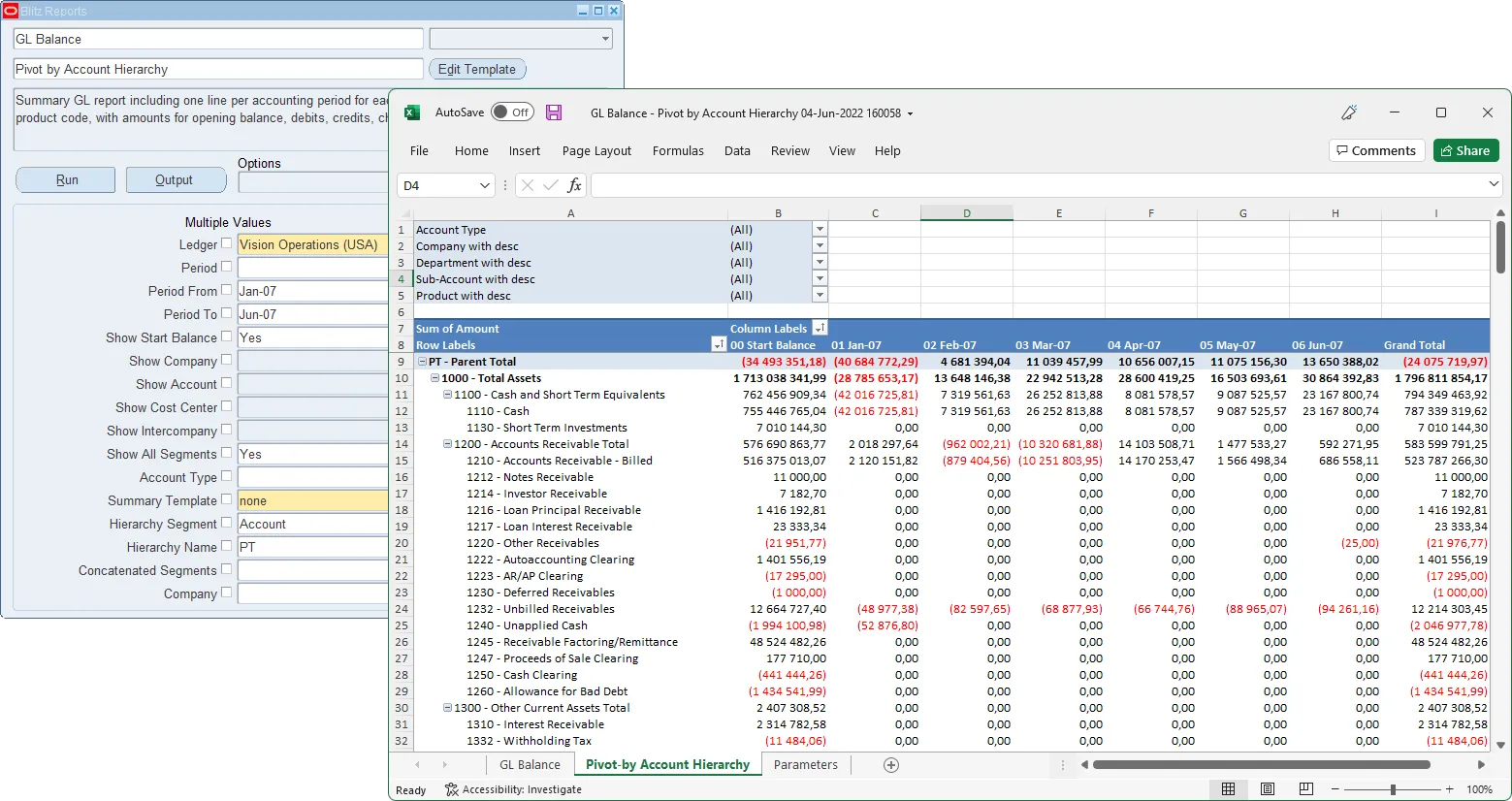
The Filters, Columns, Rows and Values fields are used to create and deliver the data in pivot table format with full drill down to details.
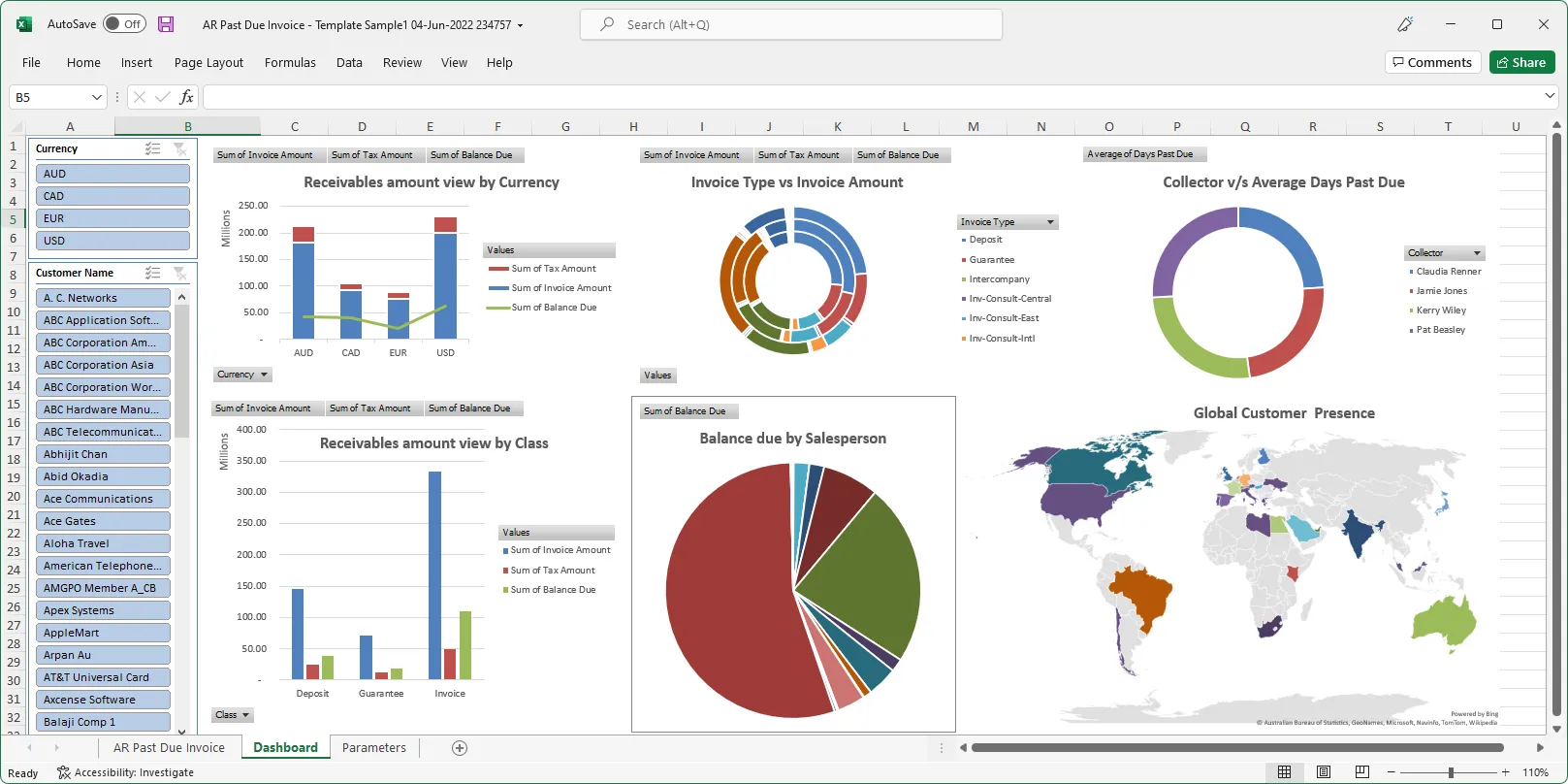
The Excel template upload functionality in Blitz Report allows users to create their own layouts by uploading an Excel template with additional sheets and charts, automatically refreshed when the report runs again. This allows to create custom dashboards and more advanced visualizations of report data.
You can download and use Blitz Report free of charge for your first 30 reports.
The installation and implementation process usually takes less than 1 hour; you can refer to our installation and user guides for specific details.
If you would like to optimize your Oracle EBS implementation and or operational reporting you can visit www.enginatics.com to review great ideas and example usage in blog. Or why not try for yourself in our demo environment.
Useful Links
Blitz Report™ – World’s fastest data upload and reporting for Oracle EBS
Oracle Discoverer replacement – importing worksheets into Blitz Report™
Blitz Report™ Questions & Answers
Supply Chain Hub by Blitz Report™
© 2025 Enginatics